

Who Are The Decision Makers?
Horse racing in the UK remains a highly popular spectator and participant sport, despite well-known and significant challenges.
Managed well, the attractiveness for owner investment and therefore the sustainability of the sport can be guaranteed by exploiting the commercial opportunities provided through race meeting attendance, media, and betting.
In any successful industry, it is crucial to have strong leadership, vision, and a sense of purpose guiding decisive action.
Policy and allocation of funds that shape the sport are driven by a disparate group of interests, individuals, and organisations. The very large number of individual bodies representing specific roles makes it incredibly difficult to understand who does what and who gets to decide. It also enables the most organised bodies and strongest individuals to be the most influential.
The British Horseracing Authority (BHA) has the accountability for leadership of the sport in the UK. This includes creating a vision and then making decisions for the management of funding in the sport.
In this section, we’ll delve into how the BHA is set up and where the balance of power lies. We will help demystify the overall structure of all the governance bodies and make very clear how weak the critical voice is for those funding the sport — the owners.
We will explore who should hold the ultimate constitutional authority over the BHA, and who should make the strategic decisions about the future of British racing on its behalf.
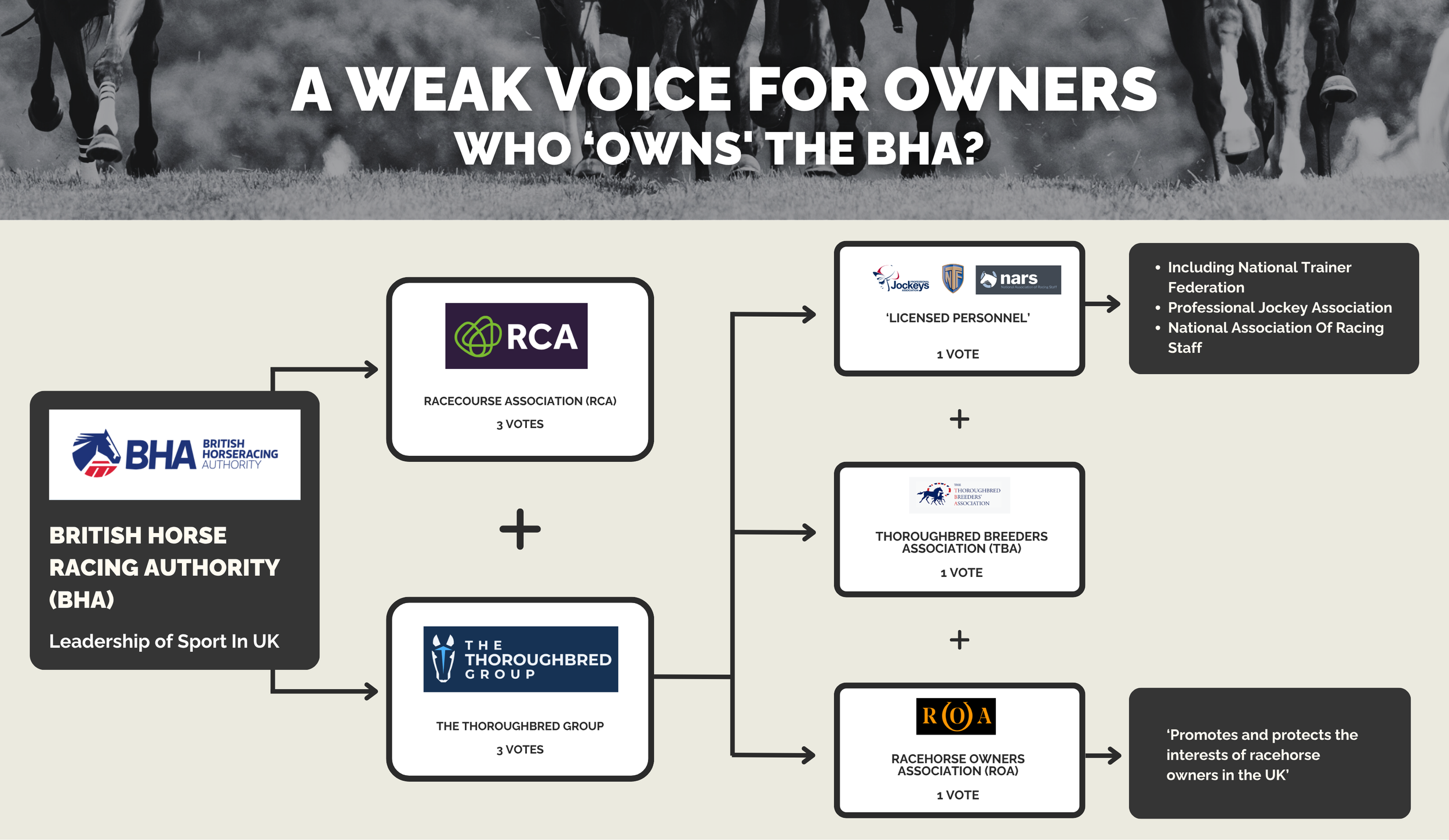
Outright owners only have 1 vote of 6 (16.7%) for certain decisions. While trainers and breeders may also be owners, the Racehorse Owners Association (ROA) has been entrusted with representing the majority of owners. In a separate section, we will explore just how many owners are members of the ROA and therefore how representative the ROA is.
The decisions that the 1 vote is used for pertain to fundamental constitutional rights rather than management of the BHA’s strategy and daily operations. Constitutional rights means how the BHA is set up and what decision rights are granted to its Board of Directors. This is the ultimate authority over the BHA. Changes in constitution require all vote holders to agree.
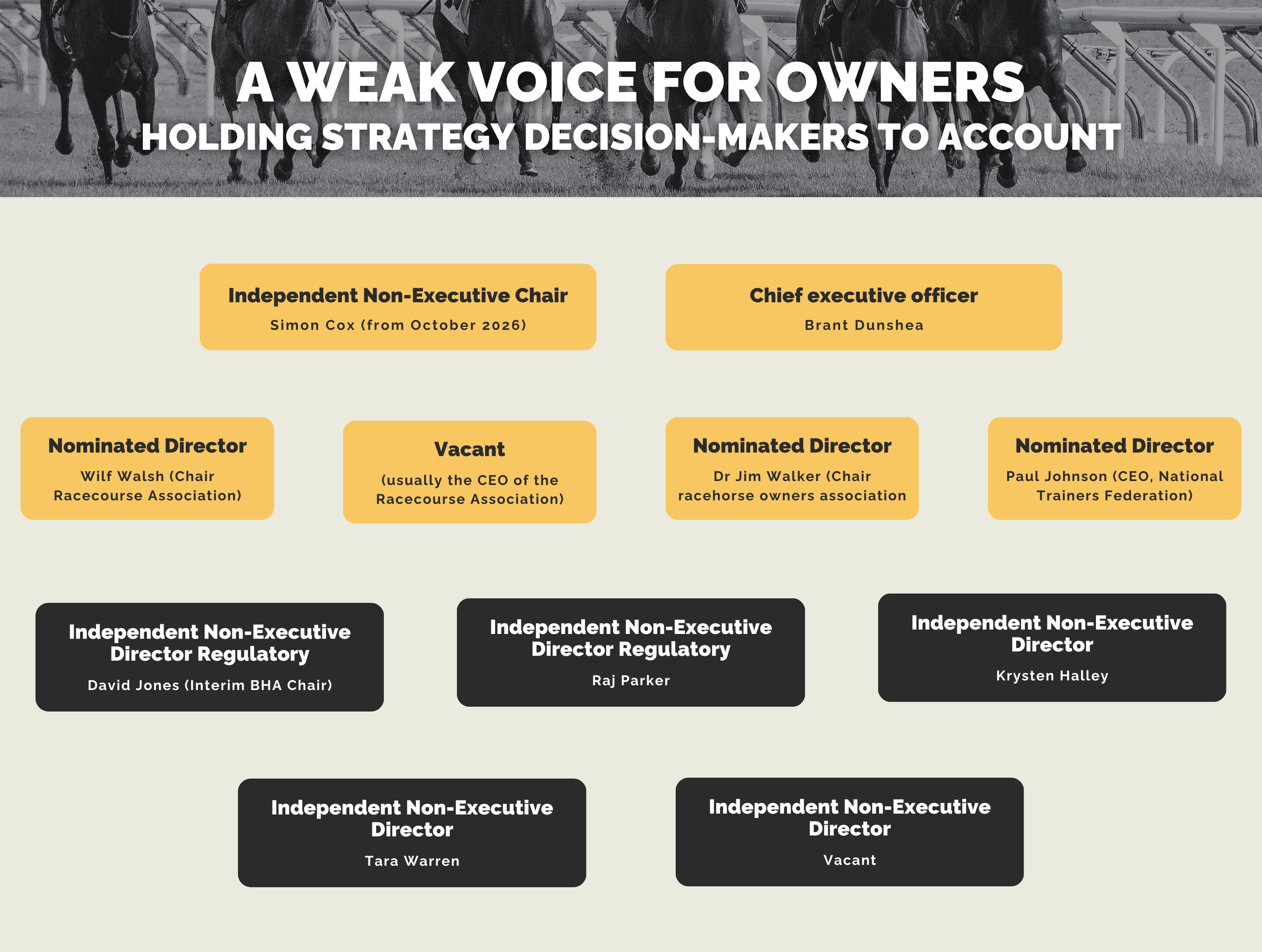
The organisations that “own” the BHA are referred to as members and are not the same thing as the people who sit on the BHA Board. The current constitution does however allow the members to nominate individuals to the Board. Racecourses get to appoint two Board members, the Thoroughbred Association two while up to 5 other independent Non-Executive Board members can be appointed. Non-Executive means they are not involved in the day to day running of the BHA. The remaining Board members are the Chair and the Chief Executive Officer.
The BHA describes the Board's principal role as providing strategic leadership and direction. In other words, the Board is there to answer questions such as:
Where is British racing going?
What should the BHA's priorities be?
Are the organisation's finances properly controlled?
Are the BHA's regulatory responsibilities being discharged properly?
The current constitution of the Board is shown in the chart below:
Who should have the ultimate constitutional authority over the BHA,
and
who should make the strategic decisions over the future of racing in Britain on behalf of the BHA?’
The answer to our two questions is that it is not necessarily the same.
The current debate about creating a fully independent BHA Board is essentially about the two questions. The debacle that followed the appointment of Lord Allen and his subsequent departure exposed the criticality of getting the right answer to the first question first.
Our assertion is that as the critical funders of the sport, Owners must have a greater say in both protecting our investments and stimulating financial growth to the benefit of the sport. That means having greater say in both ultimate constitutional authority and holding the Board to account for its strategic decision-making.
